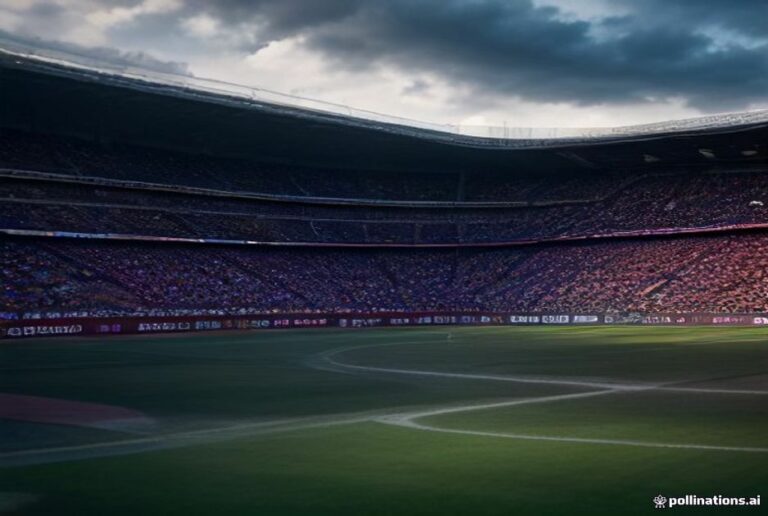

The prospect of Saúl “Canelo” Álvarez fighting at the Estadio Azteca, the cavernous cathedral of Mexican football that has also hosted two FIFA World Cup finals, appears to be gaining momentum. Eddy Reynoso, the super middleweight champion’s head trainer and manager, has publicly described the idea as a dream scenario for any Mexican boxer, signaling that discussions about bringing the sport’s biggest active star back to his home country for a stadium-scale event are moving in a serious direction.
Reynoso’s comments underscore how high the stakes would be for such an event. The Azteca, located in the working-class San Pablo Tepetlapa neighborhood on the southern edge of Mexico City, holds more than 87,000 spectators for football and has hosted concerts by global superstars, but a top-tier professional boxing card there would be unprecedented in the modern era. Mexican boxing has long thrived in intimate arenas like the Arena México and the Plaza de Toros, and in recent years on platforms such as DAZN and traditional pay-per-view. A stadium-sized outing would represent a significant departure from that model and would depend on a Mexican opponent capable of moving that many tickets.
Álvarez, who turned 36 in 2026, has spent the bulk of his recent career operating out of Las Vegas, where the T-Mobile Arena has served as his primary stage. His bouts against the likes of Gennady Golovkin, Caleb Plant, Dmitry Bivol, and Jermell Charlo have cemented his status as the face of the sport. Yet, despite his international profile, the Guadalajara native has fought only sporadically on Mexican soil since his early career, a fact that has long frustrated portions of the Mexican fan base, which considers Álvarez the most accomplished fighter the country has produced.
Bringing the champion to the Azteca would require a matchmaking choice that resonates nationally. Mexican rivals have always held a particular place in Álvarez’s résumé, from his early tests against Carlos Baldomir, Shane Mosley, and Austin Trout, to his later unification bouts. In the current landscape, possible domestic opponents are limited. Former super middleweight titleholder Carlos Adames, who was born in Nicaragua but has built his career in Mexico, and David Morrell, the Cuban-born contender now fighting out of the United States, both represent plausible stylistic matchups but lack the singular name recognition to anchor a stadium card.
Industry observers point to a generational challenge: there is no obvious heir to the kind of domestic rivalry that once defined Mexican pay-per-view, the bouts against the likes of Marco Antonio Barrera, Erik Morales, and Juan Manuel Márquez that drew millions of viewers south of the border. Without a clear homegrown foil, promoters would need to balance the spectacle against the commercial reality that an Azteca-scale event demands a marquee storyline.
Reynoso’s framing of the fight as a “dream” rather than a confirmed date suggests the team is still gauging feasibility. Staging a major fight at the Azteca involves considerations well beyond a typical arena card: turf management for the pitch, custom ring construction, weather exposure given Mexico City’s elevation and afternoon thunderstorms, and an expanded broadcast infrastructure. Recent boxing events at Wembley Stadium and AT&T Stadium have demonstrated that the logistical lift is workable, but the Azteca’s configuration and the absence of a recent precedent in boxing make it a unique undertaking.
The cultural dimension, however, may be the deciding factor. Álvarez has long carried the weight of being the standard-bearer for Mexican boxing’s golden generation, which also included Barrera, Morales, and Márquez. Those fighters regularly headlined cards at the Plaza México and other venues in the capital, building audiences that filled arenas but never stadiums. A Canelo fight at the Azteca would be the first time a Mexican boxer of his commercial magnitude attempted to fill the country’s largest sporting venue.
For Reynoso and the Canelo Camp, the message appears calculated. By invoking the language of dreams and national significance, he is signaling both to potential opponents and to promoters that the ambition is real and that the infrastructure around Álvarez is willing to entertain the kind of risk a stadium fight demands. Whether that vision translates into a signed opponent and a confirmed date will depend on the willingness of a rival’s team to step into what would unquestionably be the loudest and most demanding crowd of any fighter’s career.
Until then, the Azteca remains a possibility rather than a promise, but one whose mere mention has already reignited the broader conversation about Mexican boxing’s biggest star coming home to fight in front of his own people at a scale rarely attempted in the sport.