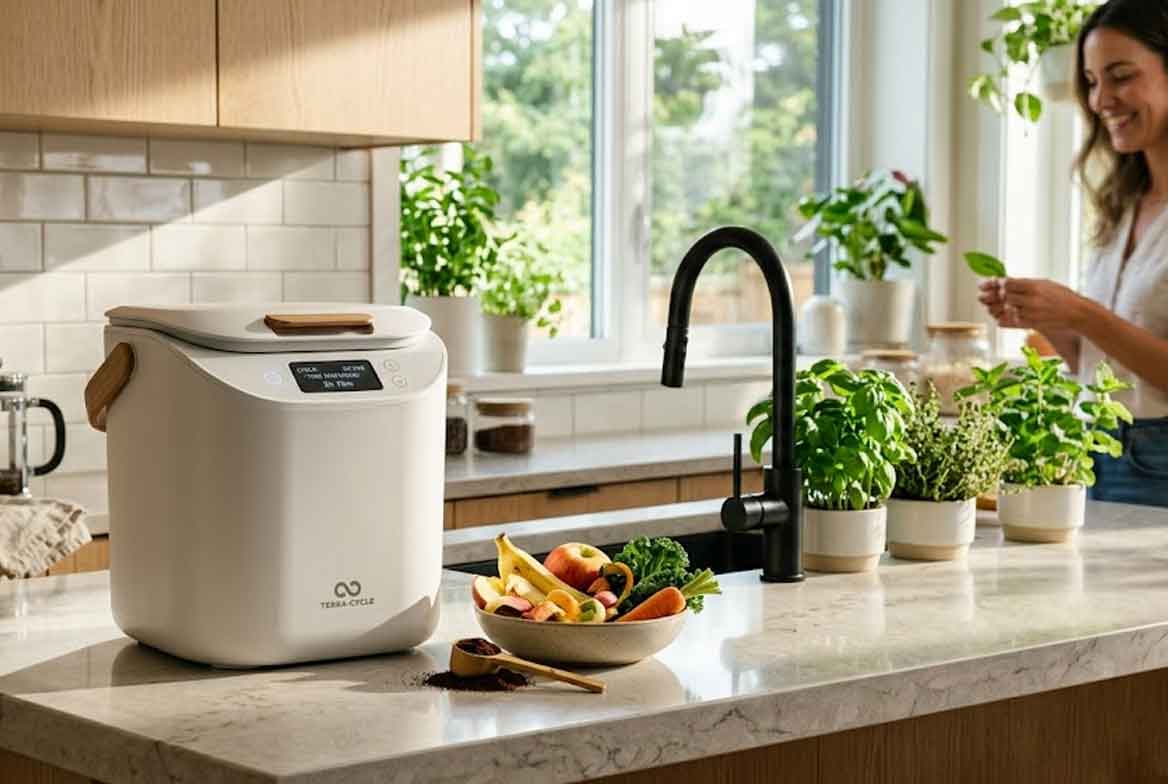

An electric kitchen composter promises to do in four hours what a backyard pile takes six months to accomplish — turning your vegetable peels, coffee grounds, and leftover pasta into a dry, crumbly soil amendment, all without attracting a single fruit fly. If you’ve ever abandoned a traditional compost bin because of the smell, the space requirements, or the sheer patience it demands, a countertop food recycler might be the appliance that finally changes your relationship with food waste.
The numbers behind food waste are hard to ignore. According to the UN Environment Programme, roughly one-third of all food produced globally is lost or wasted, contributing to nearly 10% of greenhouse gas emissions. For households, that often means a green bin sitting outside — useful, but passive. The new generation of electric compost bins brings that process indoors, onto your countertop, and under your control.
What exactly is an electric kitchen composter?
Here’s the first thing your sustainable-living expert friend would tell you over coffee: most electric kitchen composters are technically food recyclers, not biological composters. Traditional composting is a microbial process — bacteria and fungi break down organic matter over months. These machines use heat, airflow, and mechanical grinding to physically reduce food scraps into a dehydrated, granular material.
The distinction matters because the output is “pre-compost” or a soil amendment, not aged humus. It still needs to be mixed into garden soil or added to a traditional compost pile to complete the biological breakdown. Think of it as putting food waste on the fast track, not the finish line. Used correctly, a handful of this material mixed into potting soil or a raised bed is genuinely beneficial for plants — just don’t expect to pour it directly onto your tomatoes straight from the machine.
How it works: the science of “dirt” in hours
The process inside a countertop food recycler follows three elegant stages. Understanding them helps you use the device more effectively and set realistic expectations for the output quality.
The entire cycle typically runs between four and eight hours, depending on the model and the moisture content of what you load in. Most devices offer an express mode for dry scraps (three to four hours) and an eco-mode that uses less energy over a longer cycle — useful if you’re running it overnight.
The benefits of going electric
The case for an indoor composter is strongest when you stack it against the daily friction of traditional methods. Odor is the most immediate win: quality machines use activated charcoal filters to neutralize smells at the source, meaning banana peels and fish skin don’t perfume your kitchen. Fruit flies, which breed in the moisture of open compost bins, become a non-issue when food scraps are processed within 24–48 hours.
Speed is the headline feature. A backyard bin takes three to six months to produce usable compost under ideal conditions — which includes turning it regularly, maintaining the right moisture balance, and hoping your climate cooperates. An electric unit delivers a finished product the same day you load it. For urban dwellers with no outdoor space, that comparison is even more stark: the alternative isn’t a backyard bin, it’s a plastic bag in a landfill.
Space efficiency is the other compelling argument. The best countertop models are roughly the size of a bread machine — compact enough for a studio apartment kitchen, discreet enough to leave on the counter without apology. For apartment dwellers, urban gardeners with balcony planters, and anyone using a shared green bin program, an electric unit offers a level of agency and immediacy that passive systems simply can’t match.
The real competition for an electric composter isn’t a backyard pile — it’s a bin liner headed to a landfill.
Key features to look for before you buy
The electric compost bin market has matured significantly since the first generation of machines appeared around 2020. Here’s what separates a smart purchase from an expensive dust-collector.
Capacity is the starting point. Entry-level units hold around 2 litres — adequate for one or two people generating modest food scraps. Family-sized models in the 4–5 litre range are better suited for households going through significant produce. Keep in mind that loading capacity is typically less than the total bucket size, since the machine needs room to process.
Cycle time and modes matter for daily usability. A machine that only offers one slow cycle (seven to eight hours) can back up quickly if you cook every day. Look for models with an express setting and the ability to run multiple cycles back-to-back. Noise level is worth checking carefully: the grinding phase is the loudest moment, and the best machines operate below 45 decibels — quieter than a dishwasher. A unit that sounds like a blender running in the background will test your patience within a week.
Output quality varies considerably between brands. Some machines produce a coarser, more fibrous material that needs longer in a traditional compost pile before it’s plant-ready. Others — notably the Lomi with its Grow mode — produce finer particles that can be directly mixed into soil at low concentrations (around 10% by volume). Filter replacement is also a recurring cost to factor into your budget; charcoal filters typically last three to four months before they need replacing.
Electric vs. traditional composting: a fair comparison
Neither method is universally superior. If you have outdoor space and grow a large kitchen garden, a traditional bin produces a richer, more biologically active compost at a fraction of the running cost. But if you’re working with a flat, a balcony, or simply a life too busy to turn a pile, the electric kitchen composter wins on every practical metric.
Top-rated models for 2026
When comparing Lomi vs. Mill specifically — the two most discussed models in 2026 — the choice often comes down to what you value most. Lomi prioritises output quality and soil integration; Mill prioritises volume and the novelty of closing the loop entirely through its subscription programme. Both are well-built, both are legitimately quiet, and both represent a significant step up from the first generation of indoor composters that struggled with wet food and unpleasant smells.
Common mistakes to avoid with your new device
Even the best electric compost bin will underperform — or break prematurely — if you treat it like a kitchen sink disposal. Large bones, avocado pits, and whole nuts should stay out. The grinding mechanism is designed for soft-to-medium density food scraps; hard, dense materials create strain on the motor and produce uneven, chunky output. Similarly, excessive oil or liquid-heavy scraps slow the drying phase significantly and can leave a rancid residue inside the drum.
Filter maintenance is the other common oversight. Most manufacturers recommend replacing the activated charcoal filter every three to four months, but many users push this to six months and then wonder why their machine smells. The filter is doing the heavy lifting on odour control — treating it as a one-time setup cost will cost you more in the long run. Clean the drum itself with warm water and mild dish soap after every four to five cycles to prevent residue build-up on the heating elements.
Final verdict: is it worth the investment?
The honest answer depends entirely on how you live. An electric kitchen composter is one of the most genuinely useful sustainability appliances to reach the mainstream market in years — but it is also a £300–£700 purchase that runs on electricity and requires ongoing filter costs. For the right household, the return on that investment is real and measurable.
Who should buy one?
- Apartment dwellers with no outdoor composting option
- Urban gardeners who want a steady supply of soil amendment
- Households generating significant food waste who want to reduce landfill contributions
- Homeowners with outdoor space — a traditional bin may be more cost-effective long-term
- Those expecting finished, garden-ready compost straight from the machine
The key is going in with calibrated expectations. The output from an electric food recycler is a valuable soil amendment, not a finished compost. Mix it into raised beds at around 10% by volume, add it to a traditional compost pile to finish the biological process, or use it as a top dressing for established plants. When used this way, it genuinely closes the loop between your kitchen and your garden in a way that a green bin programme — however well-managed — simply can’t replicate.
The technology has matured, the market leaders have addressed the early criticisms around noise and smell, and the environmental case for diverting food waste from landfill is as strong as it’s ever been. If food waste reduction is a genuine priority and your living situation makes traditional composting impractical, a countertop food recycler is no longer a luxury gadget. In 2026, it’s a considered, practical investment in a less wasteful kitchen.