
A Giant Spider Invades the United States: The Jorō Spider’s Rapid Spread and Ecological Impact

A giant spider invades the United States, not in the plot of a B-movie horror flick, but as a tangible ecological phenomenon. The Jorō spider, a striking arachnid native to Asia, has rapidly colonized vast swathes of the U.S. since its accidental arrival in 2014, sparking significant environmental concern. While these large, vibrantly colored spiders may appear alarming, scientific consensus indicates they pose no real danger to humans or pets. Instead, the primary concern revolves around their profound impact on native ecosystems, particularly through the displacement of indigenous spider species and the alteration of local food webs across various habitats.
The jorō spider: An unexpected newcomer to the united states
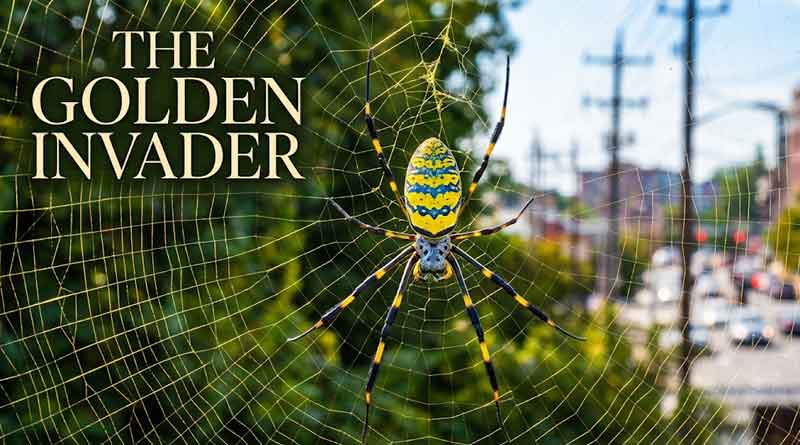
What exactly is this new arachnid causing such a stir? The Jorō spider, scientifically known as Trichonephila clavata, is an invasive species originating from Japan, China, Korea, and Taiwan. Females of this species are particularly notable for their impressive size, capable of reaching a leg span of up to 8 centimeters, roughly the size of a human hand. Their appearance is equally striking, characterized by a vibrant yellow body adorned with bold blue and red stripes, a coloration that makes them highly visible in their intricate, golden webs.
Unlike many native spiders that prefer secluded natural environments, the Jorō has demonstrated an extraordinary capacity for adaptation. It thrives in diverse settings, from bustling urban centers and the concrete jungles alongside highways to quiet suburban gardens and rural landscapes. This remarkable versatility has been a key factor in its swift and widespread expansion across the United States, allowing it to establish itself in areas where other species might struggle to survive.
From asia to america: The jorō spider’s journey and rapid spread
How did this Asian arachnid find its way across the Pacific to American shores? The arrival of the Jorō spider in the United States is largely attributed to accidental transport via international cargo shipments from Asia. Researchers believe the initial foothold was established in Georgia around 2014. Since these initial sightings, entomologists and university researchers have meticulously documented its relentless advance.
States like Georgia, South Carolina, North Carolina, Tennessee, and Maryland have already reported significant populations of Jorō spiders. Their geographical spread is not merely due to overland travel; these arachnids employ a fascinating and highly effective dispersal mechanism known as ballooning. This process involves young spiderlings spinning silk threads and releasing them into the wind, allowing them to be carried for considerable distances through the air. This aerial mode of transport explains how Jorō spiders can rapidly colonize new urban and rural areas, often appearing far from established populations.
Universities such as Clemson University and the University of Georgia have been at the forefront of monitoring this expansion through extensive field studies. Their research confirms the Jorō’s ability to establish itself in a wide array of environments, including highly disturbed urban settings, which further facilitates its rapid dispersal and colonization of new territories.
Why the jorō spider population is exploding
What factors contribute to the Jorō spider’s astonishing reproductive success and rapid population growth in its new American habitats? Recent studies highlight several key biological advantages that enable the Jorō spider to multiply at an accelerated pace. These include a high metabolic rate, which allows them to process food efficiently and grow quickly; a remarkable tolerance to cold temperatures, making them resilient in diverse climates; and a rapid life cycle, ensuring new generations emerge swiftly.
According to data published in scientific journals like Arthropoda and by organizations such as the North American Invasive Species Management Association (NAISMA), the Jorō spider population has been observed to double annually. This exponential growth is a primary driver of its continuous expansion into new geographical areas. The aforementioned ballooning method is crucial to this process, as it allows countless spiderlings to disperse simultaneously, effectively seeding new colonies across vast regions.
Adult female Jorō spiders, with their impressive 8-centimeter leg span, are easily recognizable by their vibrant yellow, blue, and red markings. They construct large, intricate golden webs that can span up to 3 meters in diameter, often found draped across gardens, pathways, and suburban areas. Male Jorōs, in contrast, are much smaller and less conspicuously colored, often going unnoticed. A peculiar aspect of their reproductive biology, documented in both their native and newly colonized territories, is their cannibalistic tendencies; females have been observed consuming males after mating, a behavior that might contribute to resource allocation for egg production.
Jorō spiders thrive in the urban jungle
How has the Jorō spider managed to establish such a strong presence in human-dominated landscapes? The Jorō spider stands out for its exceptional adaptability to urban environments, a trait that sets it apart from many native spider species. Research from institutions like the Odum School of Ecology at the University of Georgia has demonstrated that Jorō spiders can tolerate significant levels of vibration, noise, and other disturbances commonly found in cities. This resilience allows them to prosper in close proximity to human infrastructure, a stark contrast to many native spiders that are sensitive to such perturbations and tend to avoid urbanized areas.
Andy Davis, an urban ecology specialist, notes that Jorō webs frequently appear in autumn alongside busy roads, indicating their comfort and survival success in such conditions. This tolerance is a critical factor in their rapid spread through urban areas, where other species face insurmountable barriers. Their webs can be found in unexpected places: between telephone poles, strung across traffic lights, on porch railings, and even connecting power lines. This ability to integrate into and thrive within the urban fabric allows them to exploit a vast network of previously underutilized habitats, further accelerating their colonization of the United States.
Their preference for elevated, exposed locations for web building, such as eaves, utility poles, and tall vegetation, also positions them advantageously in urban settings. These spots offer abundant insect prey attracted to artificial lights and provide clear pathways for their ballooning offspring to catch the wind. This remarkable urban adaptability is a significant contributor to why a giant spider invades the United States with such apparent ease.
The ecological impact: Jorō spiders and native species displacement
What are the environmental consequences of the Jorō spider’s proliferation in the United States? While the Jorō spider may not pose a direct threat to people, its rapid advance is causing verifiable alterations in local biodiversity. Entomologists and reports from NAISMA highlight that this invasive species is displacing native orb-weaving spiders. Censuses conducted between 2014 and 2024 in affected regions reveal a concerning decline of up to 40% in native spider populations. This reduction is primarily due to intense competition for essential resources: prey, suitable web-building sites, and overall food availability.
The intricate webs of native spiders are vital components of their ecosystems, acting as natural pest control and providing food for birds and other predators. When Jorō spiders move in, their large, robust webs often outcompete or physically displace the smaller, more fragile webs of native species. This direct competition can lead to a reduction in the hunting grounds available to native spiders, impacting their ability to capture food and reproduce effectively.
Furthermore, while Jorō spiders do consume some pest insects, their varied diet means they also prey on beneficial organisms and even species that might be endangered. This indiscriminate predation can disrupt the delicate balance of the ecosystem, potentially leading to cascading effects throughout the food web. For instance, a decline in native spiders could impact local bird populations that rely on them as a food source, or lead to an increase in certain insect populations that native spiders once kept in check. The long-term consequences of this ecological disruption are still being studied, but the potential for significant shifts in local fauna is a serious concern for environmental authorities.
Are jorō spiders dangerous to humans or pets?
Given their imposing size and vibrant coloration, a natural question arises: Are Jorō spiders dangerous to people or domestic animals? Despite their formidable appearance and large size, scientific evidence consistently shows that Jorō spiders pose no significant medical risk to humans or pets. There are no recorded fatalities or medically relevant bites associated with this species in its introduced range. Entomologists like David Coyle and ecologists such as José R. Ramírez-Garofalo have explicitly stated that the Jorō spider does not represent a medical threat to either humans or household pets.
Their venom, while present, is comparable in potency to that of other common orb-weaving spiders and is typically not potent enough to cause serious harm to larger mammals. Furthermore, Jorō spiders are generally not aggressive towards people. They are more inclined to flee or remain still when disturbed, and will only bite as a last resort if they feel directly threatened or are accidentally pressed against skin. Even in such rare instances, their fangs are relatively small and often struggle to penetrate human skin effectively.
The most significant challenge for the public regarding Jorō spiders is not their toxicity, but rather the sheer nuisance caused by their prolific web-building, especially during mating season. Their large, golden webs can become quite abundant, draping across gardens, pathways, and even doorways, creating an inconvenient obstacle. Experts advise that these webs can be easily removed with a broom or a stick. While removing webs, it’s recommended to do so gently to avoid unnecessarily harming the spiders, which are, after all, a part of the local ecosystem now, albeit an invasive one.
Perspectives for the future: Living with the jorō spider
What does the future hold for the Jorō spider in North America, and what are the implications for environmental management? Scientific projections indicate that the Jorō spider will continue its expansion across North America, with the potential to eventually reach colder regions, including parts of Canada. Its remarkable tolerance to cold, high reproductive capacity, and exceptional adaptability to diverse environments make containment efforts incredibly challenging, if not impossible.
Researchers and environmental authorities are emphasizing the critical importance of ongoing monitoring to track the spider’s spread and its ecological effects. Efforts are also focused on studying and developing new management strategies to mitigate its impact on native biodiversity. These strategies might include public awareness campaigns, targeted research into biological controls (though this is often complex and risky with invasive species), and understanding how to best coexist with this new resident.
The introduction of species like the Jorō spider underscores a broader and more pressing issue: the imperative to strengthen controls at ports and along commercial trade routes. Global commerce inadvertently acts as a highway for invasive species, and the Jorō is just one example among many that highlight the need for more robust biosecurity measures. As a giant spider invades the United States, it serves as a vivid reminder of our interconnected world and the unforeseen ecological consequences that can arise from global trade. The challenge now is to learn to live with this new reality, understand its long-term effects, and adapt our environmental management practices accordingly to protect the fragile balance of native ecosystems.