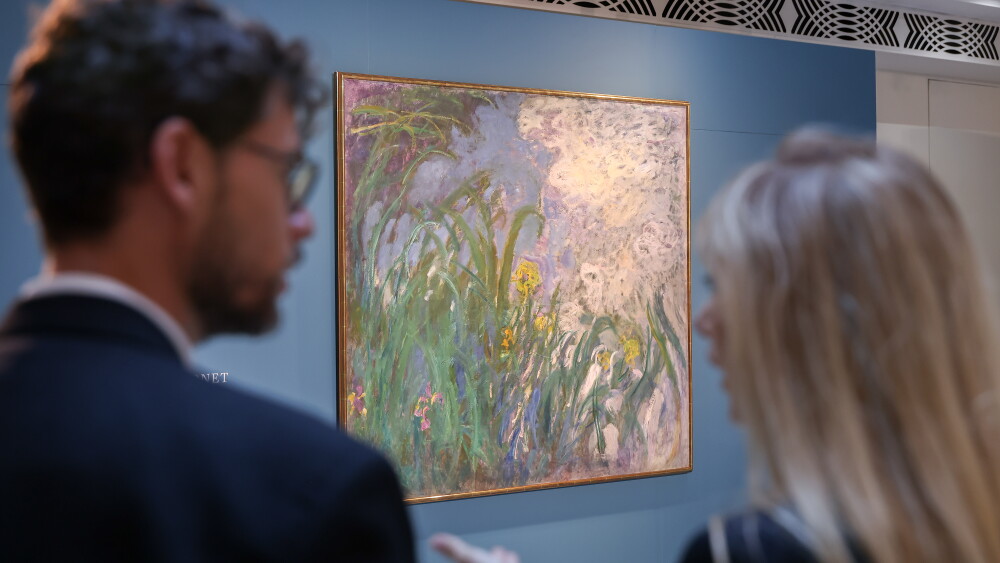

On October 22, 2026, Claude Monet’s late‑period masterpiece “Iris” fetched €50 million at a Sotheby’s auction in Paris, shattering the previous French auction record and establishing the work as the most expensive piece ever sold at a sale in the country.
A Historic Auction Milestone
The 1924‑1925 canvas, created during the final years of Monet’s life while his vision was clouded by cataracts, far exceeded its pre‑sale estimate of €22‑30 million. The final hammer price of €50 million not only topped the earlier record of €43.2 million set in 2010 for an Amedeo Modigliani sculpture, but also positioned “Iris” as the highest‑priced artwork ever auctioned in France, underscoring the growing global appetite for Impressionist and Post‑Impressionist masterpieces.
Decoding Monet’s Palette
Monet’s “Iris” exemplifies his experimental approach in the twilight of his career. The painting’s vivid hues are not merely decorative; they convey movement, depth, and an almost tactile sense of the garden environment.
- Green: vertical brushstrokes depict the leaves and stems of the lilies, suggesting continuous growth and vitality.
- Violet: applied to the flower petals, this color creates contrast with the surrounding green and helps the blossoms emerge from the surrounding foliage.
- Yellow: bright highlights illuminate sections of the flowers, adding intensity and visual depth against cooler tones.
- Blue: representing the reflected sky in the pond, the blue eliminates a distinct horizon line, merging water and sky into a seamless, immersive field.
These choices reflect Monet’s desire to dissolve boundaries between elements, inviting viewers to experience nature as a fluid, interconnected whole.
The Subject: Lilies in Giverny
“Iris” belongs to a series of large‑scale water‑lily and flower paintings Monet produced at his Giverny estate. The artist cultivated an extensive collection of lilies, both in the flowerbeds surrounding his house and in the iconic water‑lily pond. By repeatedly painting these blossoms, Monet transformed ordinary garden scenes into monumental compositions that emphasize texture, color, and light over precise botanical detail.
The work measures 159.6 cm × 180 cm, making it one of the largest canvases from Monet’s final period. Its size, combined with the artist’s mature technique, contributes to its visual impact and market desirability.
Why the Record Matters
Beyond its artistic significance, “Iris” had been held in private hands for decades, largely out of public view. Its prolonged seclusion heightened anticipation for the auction, and the final price reflects both the painting’s rarity and the heightened competition among collectors.
The previous French auction record of €43.2 million — set by a Modigliani sculpture in 2010 — demonstrates a steady upward trajectory in the value of early‑20th‑century European art. “Iris” surpasses that benchmark by nearly €7 million, marking a new benchmark for the market.
Conclusion
Claude Monet’s “Iris” stands as a testament to the artist’s relentless pursuit of sensory experience through color and brushwork. Its record‑breaking sale not only highlights the enduring appeal of Impressionist masterpieces but also signals a robust future for high‑value art transactions in Europe. As the painting changes hands, it reaffirms Monet’s legacy as a pivotal figure whose innovations continue to shape the art world more than a century after his death.
Source: caras.com.mx