
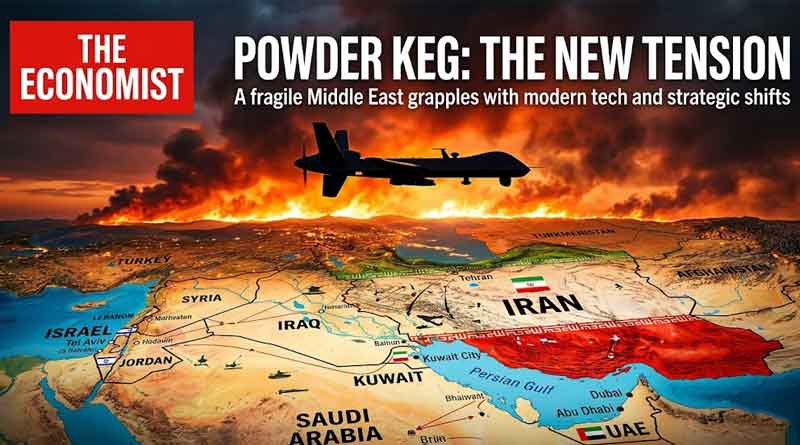

Iran attacks Israel, along with targets in the United Arab Emirates and Kuwait, marking a perilous escalation in regional tensions. On Tuesday, Iran’s military officially claimed responsibility for these widespread drone strikes, asserting they were a direct retaliation for a prior Israeli bombardment of its largest petrochemical center in Asaluyeh. This series of aggressive actions comes at a critical juncture, as Iran faces an expiring U.S. deadline to finalize an agreement aimed at de-escalating conflict in exchange for the reopening of the vital Strait of Hormuz—a deal that now appears increasingly out of reach following Tehran’s rejection of American ultimatums.
What prompted Iran’s retaliatory strikes?
The immediate trigger for Iran’s claimed attacks was an earlier Israeli strike against Iran’s most significant petrochemical hub located in Asaluyeh, near the South Pars gas field. This facility is crucial for processing approximately 50% of Iran’s petrochemical products, making it a vital economic and strategic asset. The destruction or severe damage to such a key industrial complex would represent a substantial blow to Iran’s economy and its capacity to export crucial resources, thereby eliciting a forceful response from Tehran.
Where did Iran claim to strike in Israel, the UAE, and Kuwait?
Iran’s military, through a statement broadcast by state channel IRIB, confirmed “large-scale” drone attacks overnight against several key targets across the region. The precision and coordination of these alleged strikes underscore a calculated strategy to inflict significant damage and send a clear message.
Targets in Israel: Dimona’s strategic importance
In Israel, the Iranian military claimed to have targeted “the energy generation unit and the fuel storage source of the petrochemical industries near Dimona.” This location is profoundly significant for several reasons. Dimona, situated in the Negev Desert, is widely believed to house Israel’s primary nuclear reactor and a complex of chemical facilities. Iran emphasized that these targets are “of vital importance for the economy and security of the Zionist regime” and host “the largest chemical complex of the regime.” Furthermore, Iran asserted that these facilities “are used to cover some of Israel’s military needs.” A strike, or even the credible threat of one, against such a sensitive area would be designed to demonstrate Iran’s reach and its capacity to target critical Israeli infrastructure, potentially including sites with dual civilian-military utility.
Targets in the United Arab Emirates: Jebel Ali’s critical role
In the United Arab Emirates, Iran claimed responsibility for attacks against a “repair and maintenance center” belonging to the U.S. military at the port of Jebel Ali. This port is one of the “largest” docking facilities for American vessels in the region and “provides the U.S. fleet with a fundamental support and repair facility for its vessels.” Jebel Ali is not only a major commercial port but also a crucial logistical hub for the U.S. Navy’s Fifth Fleet, which operates in the Persian Gulf, Red Sea, Arabian Sea, and parts of the Indian Ocean. Targeting such a facility would directly challenge the U.S. military presence and its operational capabilities in the region, signaling Iran’s willingness to engage assets linked to its adversaries beyond Israel itself.
Targets in Kuwait: Ahmed Al Jaber air base and U.S. forces
The Iranian military also confirmed bombardments against the Ahmed Al Jaber air base in Kuwait, which hosts U.S. military forces. This base is described as housing “radar systems and hangars capable of accommodating a variety of military aircraft,” with the 332nd Air Expeditionary Wing of the United States Air Force stationed there. An attack on Ahmed Al Jaber would represent another direct confrontation with U.S. military interests, highlighting the interwoven nature of regional security and the potential for any conflict between Iran and Israel to quickly draw in other major international players. The selection of this base underscores Iran’s intent to demonstrate its ability to strike at American power projection capabilities in the Gulf.
What are the broader geopolitical implications of these Iran attacks Israel and its allies?
The recent wave of Iran attacks Israel and U.S.-allied installations carries profound geopolitical implications, threatening to destabilize an already volatile Middle East. This escalation is not an isolated incident but rather a dramatic manifestation of a long-standing “shadow war” between Iran and its regional adversaries, primarily Israel and the United States. The explicit claims of responsibility by Iran, rather than relying on proxy forces, mark a significant shift, signaling a more direct and confrontational posture.
The Strait of Hormuz: A choke point of global significance
Central to the current crisis is the Strait of Hormuz, a narrow waterway connecting the Persian Gulf with the Arabian Sea and the open ocean. It is one of the world’s most critical maritime chokepoints, through which a substantial portion of the world’s seaborne oil passes daily. Iran has repeatedly threatened to close the strait in response to sanctions or military aggression, a move that would send shockwaves through the global economy and potentially trigger a major international conflict. The current escalation unfolds as Iran reportedly “hastens the deadline” set by the United States to reach an agreement to halt the war in exchange for the reopening of the Strait of Hormuz. With Tehran rejecting U.S. ultimatums as “incompatible” with negotiations, the prospects for a diplomatic resolution appear increasingly dim, pushing the region closer to the brink.
The strategic importance of the Strait of Hormuz cannot be overstated. Any disruption to its flow would immediately impact global oil prices, shipping insurance rates, and international trade, affecting economies worldwide. For Iran, the threat of closure serves as powerful leverage in negotiations, a deterrent against military action, and a means to pressure international actors. However, it also represents a red line for many global powers, particularly those dependent on oil supplies from the Gulf, including the U.S., Europe, and Asian nations.
The role of the United States and its regional presence
The targeting of U.S. military facilities in the UAE and Kuwait underscores the direct involvement of the United States in the broader regional power struggle. The U.S. maintains a significant military presence across the Middle East, including naval fleets, air bases, and ground forces, primarily aimed at ensuring regional stability, protecting allies, and safeguarding strategic interests, such as the free flow of oil. When Iran claims attacks on these U.S. assets, it directly challenges American hegemony and signals its readiness to confront external powers. This raises the stakes considerably, as any direct engagement with U.S. forces could rapidly spiral into a much larger, more devastating conflict, potentially drawing in other regional and global players.
The U.S. administration, having issued deadlines and ultimatums, now faces a critical test of its foreign policy. The rejection of these terms by Tehran, coupled with the alleged attacks, places immense pressure on Washington to respond decisively, yet carefully, to avoid further escalation. The balance between deterrence and de-escalation becomes exceedingly delicate in such a high-stakes environment.
The “shadow war” between Iran and Israel: A history of covert operations
The recent Iran attacks Israel are the latest chapter in a long-running “shadow war” characterized by covert operations, cyberattacks, assassinations, and proxy conflicts rather than direct military confrontation. For decades, both nations have engaged in a complex dance of sabotage and retaliation, often denying involvement or using third parties to carry out attacks. Israel has been accused of targeting Iran’s nuclear program through assassinations of scientists and cyberattacks like Stuxnet, as well as striking Iranian military assets in Syria. Iran, in turn, has supported groups like Hezbollah in Lebanon and various militias in Iraq and Syria, which pose threats to Israel and U.S. interests.
The alleged drone strikes, particularly the explicit claim of responsibility, suggest a departure from the traditional “shadow” tactics, pushing the conflict into a more overt phase. This shift increases the risk of miscalculation and direct military engagement, making the current situation exceptionally dangerous.
Economic ramifications: Impact on global markets and energy security
The targeting of Iran’s petrochemical facilities in Asaluyeh, followed by Iran’s alleged retaliatory strikes, carries significant economic ramifications. The petrochemical industry is a cornerstone of Iran’s economy, generating substantial revenue, particularly under the weight of international sanctions. Disruptions to this sector can severely impact Iran’s financial stability and its ability to fund its regional activities.
Conversely, any successful Iranian strikes, particularly those that might affect shipping lanes or energy infrastructure in the Gulf, could trigger a sharp increase in global oil and gas prices. Investors and markets react nervously to instability in the Middle East, leading to increased volatility. Energy security for consumer nations becomes a paramount concern, potentially prompting strategic oil reserve releases or a scramble for alternative supplies. The long-term economic stability of the region, heavily reliant on oil and gas exports, would also be jeopardized, deterring foreign investment and hindering economic development.
What types of weapons were reportedly used in the attacks?
According to the Iranian military’s statement, the attacks were conducted using “drones ‘a gran escala'”—large-scale drone attacks. The use of drones in such a high-profile, multi-front operation highlights a significant shift in modern warfare and Iran’s evolving military capabilities. Drones offer several strategic advantages: they are relatively inexpensive to produce compared to manned aircraft, they can be launched from considerable distances, and their use minimizes the risk to human pilots, making them an attractive option for retaliatory strikes where plausible deniability or controlled escalation is desired.
The deployment of drones against targets in Israel, the UAE, and Kuwait demonstrates Iran’s ability to project power across the region and potentially overwhelm air defense systems with swarms of unmanned aerial vehicles. This technology allows for precision strikes, intelligence gathering, and psychological warfare, adding a new layer of complexity to the regional security landscape. The effectiveness of these drone attacks, and the extent of the damage inflicted, will be crucial in shaping future responses and military doctrines.
What are the potential future scenarios for the Middle East following these attacks?
The immediate aftermath of these claimed Iran attacks Israel and U.S.-allied targets presents a highly unpredictable and dangerous future for the Middle East. Several scenarios could unfold, each with varying degrees of risk and international implications.
Scenario 1: Further escalation and direct conflict
The most alarming scenario involves a tit-for-tat escalation where each side responds with increasingly severe military actions. Israel might launch further strikes against Iranian nuclear or military facilities, potentially deeper within Iran’s territory. Iran, in turn, could activate its network of proxy forces across the region, targeting Israeli interests, shipping, or U.S. bases. Such a cycle of retaliation could quickly spiral out of control, leading to a direct military confrontation between Iran and Israel, and potentially drawing the United States into a full-scale regional war. The risk of miscalculation, accidental engagement, or an overreaction from any party is extremely high, especially given the heightened tensions and the strategic importance of the targets involved.
Scenario 2: Diplomatic efforts and de-escalation attempts
Despite the current hostilities, there remains a possibility for renewed diplomatic efforts to de-escalate the situation. International actors, including the United Nations, European powers, and other regional states, might intensify their mediation efforts to prevent a wider conflict. The U.S., while condemning Iran’s actions, might also explore back-channel communications or indirect negotiations to cool tensions and revive discussions about the Strait of Hormuz or broader nuclear agreements. However, given Iran’s rejection of recent U.S. ultimatums and the explicit nature of these attacks, the pathway to de-escalation appears fraught with challenges and requires significant concessions from all sides.
Scenario 3: Prolonged “shadow war” with increased intensity
Another possibility is that the conflict reverts to a “shadow war” but with significantly increased intensity and frequency. Instead of full-scale conventional warfare, both sides might continue to engage in covert operations, cyberattacks, and proxy skirmishes, but with a greater willingness to claim responsibility for certain actions to send clearer messages of deterrence. This scenario would maintain a high level of instability and unpredictability, constantly threatening to break out into open conflict, but without immediately crossing the threshold into all-out war. The region would remain a hotbed of tension, impacting trade, investment, and daily life.
Scenario 4: Regional realignment and shifting alliances
The current crisis could also accelerate existing trends of regional realignment. Countries like Saudi Arabia and other Gulf states, already wary of Iran’s ambitions, might further solidify their alliances with Israel and the U.S., potentially leading to more overt security cooperation. Conversely, Iran might seek to strengthen its ties with other global powers, such as China or Russia, to counter perceived Western and Israeli aggression. These shifting alliances could redraw the geopolitical map of the Middle East, creating new blocs and exacerbating existing rivalries, making future conflict resolution even more complex.
Ultimately, the path forward is highly uncertain. The gravity of Iran attacks Israel and its allies cannot be overstated. The world watches with bated breath as leaders in Tehran, Jerusalem, Washington, and other capitals weigh their next moves, understanding that the wrong decision could ignite a conflagration with devastating consequences for the entire globe.