
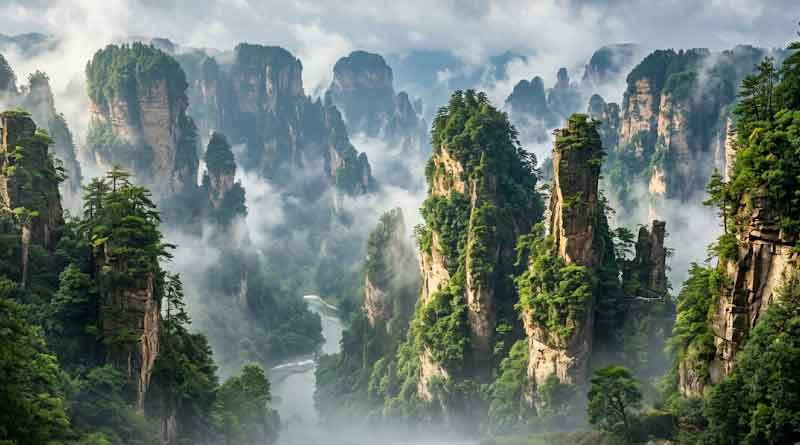

The breathtaking landscapes that inspired the iconic floating mountains from Avatar in China are not a figment of a filmmaker’s imagination, but a tangible, awe-inspiring reality found within the Wulingyuan Scenic Area of Zhangjiajie National Forest Park in Hunan Province. This spectacular destination, with its towering sandstone pillars shrouded in mist, served as the primary muse for James Cameron’s fictional world of Pandora, offering visitors a chance to step into a cinematic dreamscape.
What are the floating mountains from Avatar in China?
The “floating mountains” from *Avatar* are directly inspired by the unique geological formations found in the Wulingyuan Scenic Area, which is part of the Zhangjiajie National Forest Park in Hunan Province, China. These are not literally floating, but appear to defy gravity due to their sheer verticality and the frequent mist and fog that envelop their bases, creating an illusion of airborne islands.
Where exactly are the Avatar-inspired floating mountains located in China?
These incredible formations are situated within the Wulingyuan Scenic and Historic Interest Area, a vast natural reserve that encompasses several parks, most notably the Zhangjiajie National Forest Park. This entire region is located in the northwestern part of Hunan Province in south-central China. It’s a protected area recognized globally for its unparalleled natural beauty.
How did Zhangjiajie inspire James Cameron’s Avatar?
During the pre-production phase of James Cameron’s groundbreaking film *Avatar* in 2009, his creative team embarked on a global search for natural landscapes that could serve as tangible inspiration for the alien world of Pandora. The distinctive and otherworldly appearance of the Zhangjiajie sandstone pillars, with their dramatic verticality and often ethereal, mist-shrouded peaks, immediately captivated the filmmakers. They saw in these towering formations the perfect blueprint for the “Hallelujah Mountains” of Pandora, translating the real-world geology into a fantastical, gravity-defying spectacle. One particular peak in the park, originally named “Southern Sky Column,” was even officially renamed “Avatar Hallelujah Mountain” in 2010 to commemorate its profound influence on the film.
What is the geological origin of Zhangjiajie’s unique pillars?
The striking sandstone pillars of Wulingyuan are the result of millions of years of geological processes involving erosion, weathering, and uplift. The region is primarily composed of quartz sandstone, a relatively soft sedimentary rock. Over eons, tectonic plate movements caused the land to uplift, creating a plateau. Subsequently, water and wind, particularly the region’s humid subtropical climate with abundant rainfall, began to carve intricate patterns into the landscape. Rainwater seeped into cracks and fissures, freezing and expanding in colder temperatures, gradually widening these crevices. Rivers and streams further eroded the softer rock, leaving behind the more resistant, harder sandstone as towering, isolated pillars. This relentless process of differential erosion has sculpted over 3,000 distinct pillars and peaks, some soaring more than 200 meters (650 feet) into the sky, creating a landscape unlike any other on Earth.
Why is Wulingyuan a UNESCO World Heritage site?
The Wulingyuan Scenic and Historic Interest Area was designated a UNESCO World Heritage site in 1992, primarily for its outstanding universal value as a natural landscape. The UNESCO inscription recognizes its exceptional geological formations, specifically the thousands of quartz sandstone pillars, along with its rich biodiversity and significant ecological importance. The site is home to a vast subtropical forest ecosystem, supporting a wide array of plant and animal species, including several endangered ones. Its unique topography creates diverse microclimates, fostering a high level of endemism. Furthermore, Wulingyuan serves as an important site for geological research and education, showcasing the dynamic forces that shape our planet.
What can visitors expect to see and do in Zhangjiajie National Forest Park?
A visit to Zhangjiajie National Forest Park, the heart of the floating mountains from Avatar in China, promises an unforgettable adventure through a landscape of unparalleled beauty. Visitors can expect to be immersed in a world of towering peaks, deep valleys, lush forests, and crystal-clear streams. The park offers an extensive network of well-maintained trails, observation decks, and modern infrastructure to enhance the exploration experience.
Exploring the park’s main areas
- Yuanjiajie Scenic Area: This is arguably the most famous section, home to the “Avatar Hallelujah Mountain.” It offers numerous viewpoints, including the spectacular “First Bridge Under Heaven,” a natural rock bridge connecting two colossal peaks. The Bailong Elevator, a glass-sided outdoor elevator built into the side of a cliff, provides a dramatic ascent or descent.
- Tianzi Mountain (Son of Heaven Mountain): Known for its “sea of clouds,” “pinnacles of rock,” “moon brightened by the forest,” and “winter snow” vistas. It offers panoramic views of the entire Wulingyuan area, with cable car access providing breathtaking aerial perspectives.
- Golden Whip Stream: A serene valley walk winding alongside a crystal-clear stream, flanked by towering cliffs and lush vegetation. It’s a relatively flat and easy hike, perfect for enjoying the tranquility and spotting wildlife.
- Yellow Dragon Cave: While not directly featuring the pillars, this massive limestone cave system is a natural wonder in itself, boasting impressive stalactites, stalagmites, underground rivers, and vast chambers.
- Baofeng Lake: A picturesque artificial lake nestled among the mountains, offering boat rides that provide stunning reflections of the surrounding peaks and a chance to enjoy traditional folk songs.
Practical activities and experiences
Beyond sightseeing, Zhangjiajie offers a range of activities for different interests:
- Hiking: Numerous trails cater to all fitness levels, from gentle strolls along the Golden Whip Stream to challenging climbs to remote viewpoints.
- Photography: The ever-changing light, mist, and dramatic rock formations make it a paradise for photographers. Early mornings and late afternoons often provide the best conditions.
- Cable Car Rides: The Tianzi Mountain cable car and the Yangjiajie cable car offer incredible aerial views and save significant hiking time.
- Bailong Elevator: Experience the world’s tallest outdoor elevator, a marvel of engineering that offers unique perspectives of the cliffs.
- Glass Bridges and Skywalks: For the adventurous, the Zhangjiajie Grand Canyon features the world’s highest and longest glass-bottomed bridge, offering an exhilarating, albeit dizzying, experience.
- Cultural Immersion: Explore local Tujia ethnic minority culture through performances, traditional architecture, and cuisine in nearby towns like Zhangjiajie City or Wulingyuan Town.
When is the best time to visit the floating mountains from Avatar in China?
The best time to visit Zhangjiajie National Forest Park and witness the floating mountains from Avatar in China largely depends on personal preference regarding weather and crowd levels. Generally, spring (April-May) and autumn (September-October) are considered ideal. During these months, the weather is pleasant, temperatures are mild, and the scenery is vibrant with lush greenery or autumnal colors. The chances of clear skies are higher, offering excellent visibility for photography and enjoying the panoramic views. However, these are also peak tourist seasons, so expect larger crowds.
Summer (June-August) is hot and humid, with frequent rainfall and a higher likelihood of mist and fog, which can obscure views but also create an ethereal, “floating” effect. Winter (November-March) brings colder temperatures, and sometimes snow, transforming the landscape into a serene, snow-capped wonderland. While some areas might be less accessible due to ice, the winter scenery can be uniquely beautiful and less crowded.
What unique biodiversity can be found in Wulingyuan?
The Wulingyuan Scenic Area is not just a geological marvel but also a biodiversity hotspot. Its subtropical forests are incredibly rich in flora and fauna, contributing significantly to its UNESCO World Heritage status. The unique topography and varied microclimates within the park support a vast array of plant species, including ancient trees, rare orchids, and medicinal herbs. Over 3,000 species of plants have been identified, many of which are endemic to the region.
The park is also a sanctuary for numerous animal species. Visitors might encounter diverse birdlife, including pheasants and various songbirds. Mammals like the rhesus macaque (monkeys), which are often seen by tourists, civets, and several deer species, also inhabit the dense forests. The area is particularly important for the conservation of several endangered species, making it a critical ecological zone in China.
How to get to Zhangjiajie National Forest Park?
Accessing the floating mountains from Avatar in China involves traveling to Zhangjiajie City, which serves as the main gateway. The most common ways to reach Zhangjiajie are:
- By Air: Zhangjiajie Hehua International Airport (DYG) has direct flights from major Chinese cities like Beijing, Shanghai, Guangzhou, and Chengdu. From the airport, taxis or shuttle buses can take you to Wulingyuan Town or the park entrances.
- By Train: Zhangjiajie Railway Station is well-connected to various cities across China. High-speed rail connections are becoming more prevalent, making train travel a comfortable option. From the railway station, local buses or taxis are available to reach the park.
- By Bus: Long-distance buses connect Zhangjiajie City with neighboring cities and provinces. Once in Zhangjiajie City, local buses frequently run to the different park entrances, particularly the Wulingyuan entrance.
Once at the park, an efficient internal shuttle bus system connects the various scenic spots, cable car stations, and elevator entrances, making it easy to navigate the vast area.
Is visiting the Avatar-inspired mountains worth it?
Absolutely. Visiting the Avatar-inspired mountains in China, specifically Zhangjiajie National Forest Park, is an experience that transcends mere tourism. It’s an opportunity to witness one of Earth’s most extraordinary natural wonders, a landscape so unique and breathtaking that it inspired a cinematic masterpiece. The sheer scale of the sandstone pillars, the mystical atmosphere created by the mist, and the rich biodiversity combine to create a truly immersive and unforgettable journey. Whether you’re a nature enthusiast, a photographer, a film buff, or simply seeking an adventure that pushes the boundaries of imagination, Zhangjiajie offers a profound sense of awe and wonder that will stay with you long after you’ve left its “floating” peaks.
The journey to the real-life Pandora is more than just a trip; it’s an encounter with the raw power and artistry of nature, a reminder that the most fantastical landscapes can often be found right here on our own planet. The floating mountains from Avatar in China stand as a testament to the Earth’s enduring capacity to surprise and inspire.