
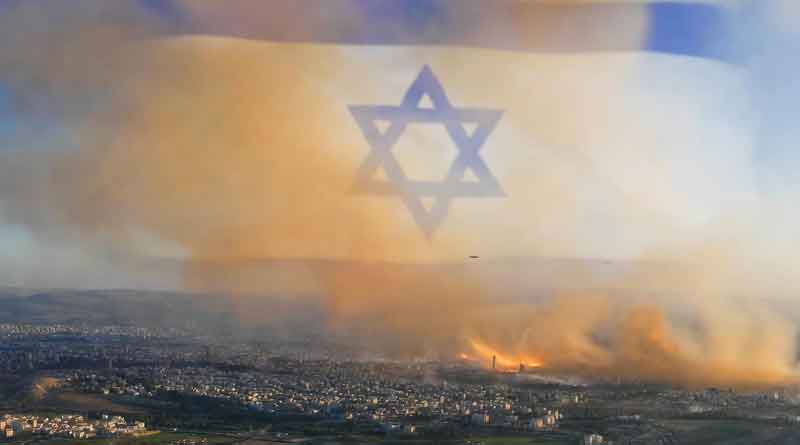

Israel bombs Syria, launching airstrikes against Syrian regime infrastructure in the southern part of the country, a move that immediately escalates fears of a new and perilous front in the already raging Middle East conflict. The Israeli military confirmed the attacks, stating they were a direct retaliation against Syrian government forces for recent assaults on the Druze minority in the Sweida region. This development, while distinct from the broader war involving Israel, the United States, and Iran, injects a fresh layer of volatility into a region already reeling from profound sectarian tensions and widespread confrontation, casting a long shadow over stability in the Levant.
The immediate catalyst: Protecting the Druze in Sweida
What prompted Israel’s latest military action against Syria?
According to a statement released by the Israel Defense Forces (IDF) on Friday, March 20, 2026, their overnight operation targeted a headquarters and weapons depots within Syrian regime military compounds in southern Syria. This was presented as a direct response to events on Thursday, March 19, 2026, during which Druze civilians in the Sweida region were reportedly attacked by Syrian military forces. The IDF explicitly warned that it “will not allow the Druze in Syria to be targeted by attacks and will continue to act to ensure their protection,” adding that it “continues to closely monitor the evolution of the situation in southern Syria.” This assertion of protective responsibility marks a significant shift in Israel’s public posture regarding internal Syrian affairs, particularly concerning its minorities.
The Druze, a distinct ethno-religious group, primarily reside in Syria, Lebanon, and Israel. In Syria, they are concentrated in the Sweida governorate, where they form a significant majority. Their unique faith and historical autonomy have often placed them in a precarious position amidst the shifting sands of Syrian politics. While traditionally adept at navigating complex allegiances, the civil war and its aftermath have severely tested their resilience. Israel’s declared commitment to their protection resonates deeply, especially given the strong bonds between Druze communities across the borders, including the sizable Druze population within Israel itself, many of whom serve with distinction in the IDF.
Syria post-Assad: A nation grappling with new leadership and old divisions
How has the overthrow of Bashar al-Assad impacted Syria’s internal dynamics and minority groups?
The landscape of Syria underwent a seismic transformation in December 2024 with the overthrow of the regime of former dictator Bashar al-Assad. This monumental shift brought a new era, with Ahmed al-Sharaa ascending to the presidency. His administration immediately faced the daunting task of governing a fractured nation, deeply scarred by years of civil war and entrenched sectarian animosities. The power vacuum left by Assad’s departure, whose family was Alawite, opened the door for the rise of Sunni-majority forces, reflecting the demographic reality of the country. However, this transition has not been without immense friction and violence, particularly for Syria’s diverse array of minority groups.
The new government, while aiming to stabilize the nation, has struggled to build trust among the numerous ethnic and religious minorities that populate Syria. Beyond the dominant Sunni population, communities such as the Alawites, Druze, Bedouins, and Kurds have long held distinct identities and, at times, faced persecution. The inherent mistrust among these groups, often fueled by historical grievances and competition for resources and influence, has become one of President al-Sharaa’s most formidable challenges. The promises of a new, more inclusive Syria have been repeatedly undermined by outbreaks of brutal sectarian violence, signaling that the deep wounds of the past are far from healed.
A timeline of escalating sectarian violence in 2025
What specific acts of sectarian violence preceded Israel’s intervention in Syria?
The year 2025 proved to be a particularly brutal chapter in Syria’s post-Assad struggle for stability, marked by several devastating incidents of sectarian violence that underscored the precarious position of minority groups. One of the most horrific episodes occurred in March 2025, when a series of massacres targeting Alawites left an estimated 1,600 dead. This horrific violence was widely interpreted as, at least in part, an act of revenge, given that the Assad family, who had ruled Syria for decades, belonged to the Alawite sect. The sheer scale of these killings sent shockwaves across the region, highlighting the deep-seated desire for retribution that festered beneath the surface of the new political order.
Just a few months later, in July 2025, the Sweida region, predominantly Druze, became the epicenter of intense clashes between Bedouin tribes and the Druze religious minority. These confrontations resulted in over 100 fatalities, further destabilizing an already volatile area. The violence erupted after the influential Druze cleric Sheikh Hikmat al-Hajri issued a scathing statement. He accused government troops, who had entered Sweida with the initial approval of the Druze spiritual leadership, of violating a previous ceasefire agreement. Sheikh al-Hajri then galvanized local fighters, urging them to confront what he vehemently described as a “barbaric attack” against his community. This incident laid bare the fragility of agreements between the new government and local leaderships, demonstrating how quickly tensions could ignite into deadly conflict when trust erodes. These events collectively painted a grim picture of a Syria struggling to contain its internal divisions, setting the stage for external actors like Israel to justify intervention based on humanitarian protection.
Israel’s evolving role: From strategic strikes to declared protector
Why has Israel adopted the role of “defender of the Druze” in Syria?
Israel’s public assertion of its role as a defender of the Druze in Syria represents a notable evolution in its foreign policy and military doctrine concerning its northern neighbor. Historically, Israeli military actions in Syria have largely focused on preventing the transfer of advanced weaponry to Hezbollah, neutralizing Iranian military entrenchment, and responding to direct threats originating from Syrian territory. These actions were often characterized by strategic precision and a degree of operational ambiguity. However, the declaration of intent to protect the Druze minority introduces a new, more overt dimension to Israel’s involvement, moving beyond purely security-driven objectives to encompass a humanitarian or protective mandate.
This shift is not entirely without precedent, as Israel has long maintained strong ties with Druze communities, both within its own borders and in neighboring countries. The Druze in Israel are fully integrated into society, serving prominently in the IDF and holding significant positions in public life. This shared heritage and deep-seated loyalty create a powerful moral and strategic imperative for Israel to safeguard their brethren across the border. The perceived vulnerability of the Druze in post-Assad Syria, especially in the face of escalating sectarian violence and the new government’s inability or unwillingness to protect them, has likely solidified Israel’s resolve. By stepping into this protective role, Israel aims to prevent further atrocities, maintain regional stability on its northern flank, and potentially cultivate goodwill and influence among a key minority group that could serve as a buffer against hostile forces. This proactive stance, however, also carries significant risks, potentially drawing Israel deeper into Syria’s internal conflicts and further complicating the already volatile regional security landscape.
The broader regional conflagration: Syria as a new front
How does Israel’s strike in Syria connect to the wider Middle East conflict?
While Israel’s recent strike on Syria is specifically framed as a response to attacks on the Druze minority, it cannot be viewed in isolation from the broader, devastating regional conflagration that has gripped the Middle East since late February 2026. This wider conflict, described by sources as a “war unleashed by an attack by the United States and Israel against Iran,” has seen Tehran respond with retaliatory actions against more than a dozen countries across the region. The initial phase of this conflict rapidly opened a new front in Lebanon, where Hezbollah, a powerful Shiite militia extensively supported militarily and financially by the Iranian regime, has been engaged in fierce combat with Israeli forces.
The insertion of Syria into this already complex and multi-front conflict significantly ratchets up the regional stakes. For years, Syria has been a crucial arena for proxy warfare, with various international and regional powers vying for influence. Iran has long used Syrian territory as a conduit for arms and personnel to its proxies, including Hezbollah, and has established its own military presence there. Israel’s previous strikes in Syria have largely aimed at disrupting this Iranian logistical chain and preventing the establishment of a permanent military threat on its border. Now, with Israel actively intervening in Syria under the banner of Druze protection, the lines between these separate, yet interconnected, conflicts blur even further. Syria risks becoming a direct battleground where the broader Israel-Iran war is fought, potentially drawing in other regional and international actors and exacerbating an already catastrophic humanitarian situation. The interconnectedness of these fronts means that an escalation in one area can have immediate and severe repercussions across the entire Middle East, pushing the region closer to an all-out, devastating confrontation.
Geopolitical ramifications: A dangerous precedent for intervention
What are the potential geopolitical consequences of Israel’s actions in Syria?
The decision by Israel to bomb Syria, particularly under the pretext of protecting a minority group, sets a dangerous precedent and carries profound geopolitical ramifications for the entire Middle East. This type of intervention, while potentially lauded by some as a humanitarian imperative, could easily be perceived by others as an infringement on national sovereignty and a further destabilization of an already fragile state. For the new Syrian government under Ahmed al-Sharaa, this act of foreign intervention complicates its efforts to consolidate power and restore order, potentially undermining its legitimacy and fueling internal dissent. It forces Damascus into a difficult position, having to balance its response to external aggression with its ongoing struggles against internal sectarianism.
Furthermore, Israel’s expanded role in Syria risks provoking a more direct and forceful response from Iran and its proxies. Tehran views Syria as a vital strategic asset in its regional influence network. Any perceived Israeli overreach, especially one that impacts the Syrian regime’s control or stability, could trigger a robust counter-response, potentially escalating the intensity and scope of the already simmering conflict. This could manifest in increased rocket fire from Hezbollah in Lebanon, more sophisticated drone attacks, or even direct Iranian military action from within Syria. The risk of miscalculation by any party is exceptionally high, with each escalation raising the specter of a broader regional war that could draw in major global powers, turning the Middle East into a theater of an even larger international confrontation. The international community, already stretched thin by multiple crises, watches with bated breath, concerned that this new front could unravel any remaining semblance of regional stability.
Historical context: A long history of cross-border tensions
How does this latest Israeli action fit into the historical context of Israel-Syria relations?
The recent Israeli airstrikes in Syria, while carrying new implications due to their stated humanitarian motive, are not an isolated incident but rather the latest chapter in a long and often hostile history between the two nations. Since the 1948 Arab-Israeli War, and particularly following the 1967 Six-Day War, during which Israel captured the Golan Heights from Syria, the border has been a flashpoint of tension. The Golan Heights remains a deeply contested territory, strategically vital for both nations, and its status has been a constant source of friction.
For decades, even during periods of relative calm, Israel has maintained a policy of preventing threats from materializing on its northern border. This has frequently translated into military operations targeting Syrian military assets, Iranian-backed militias, and weapons convoys destined for Hezbollah. These operations were often characterized by their covert nature and Israel’s deliberate policy of ambiguity regarding responsibility. However, the current intervention, explicitly framed as protecting the Druze minority in the wake of significant internal Syrian political shifts and escalating sectarian violence, marks a departure from this historical pattern. It signifies a more overt and perhaps more deeply entangled involvement in Syria’s internal affairs, potentially shifting the dynamics of a conflict that has always been complex. While the methods of air strikes may be familiar, the declared rationale and the context of a new Syrian government grappling with widespread instability imbue this latest action with unprecedented significance, underscoring the ever-present volatility of this critical geopolitical fault line.
The precarious path ahead: Navigating an escalating crisis
What are the likely future implications of Israel’s intervention in Syria?
The decision by Israel to bomb Syria, ostensibly to protect the Druze minority, thrusts an already volatile Middle East into an even more precarious and unpredictable future. This act of intervention, occurring in the turbulent aftermath of Bashar al-Assad’s overthrow and amidst a broader regional conflict, fundamentally alters the calculus for all players involved. The immediate consequence is the undeniable opening of a new front, transforming Syria from a proxy battleground into a more direct arena for the wider Israel-Iran confrontation. This escalation not only threatens to deepen the military entanglement of Israel in Syrian internal affairs but also risks provoking a more aggressive and widespread response from Iran and its network of regional allies, including Hezbollah.
Looking ahead, the stability of the new Syrian government under Ahmed al-Sharaa will be severely tested. Its inability to protect its own minorities, coupled with external intervention, could erode its authority and further fragment the nation. The cycle of sectarian violence, exemplified by the tragic events of 2025, shows no signs of abating and may intensify as various factions seek to exploit the chaos or retaliate for perceived injustices. For the Druze community, while Israel’s protection may offer a temporary shield, it also places them squarely in the crosshairs of a larger conflict, potentially making them targets for other aggrieved parties. The international community faces an increasingly complex challenge, as diplomatic efforts to de-escalate the broader regional conflict become even more difficult with the emergence of new, emotionally charged fronts. The path ahead is fraught with peril, and without a concerted effort to address the root causes of instability and foster genuine reconciliation, the Middle East risks spiraling into an even more destructive and widespread conflagration.
This evolving situation demands careful monitoring and a deep understanding of its multifaceted dimensions. The decision by Israel to bomb Syria is not merely a localized military action; it is a significant geopolitical maneuver with the potential to reshape alliances, ignite dormant conflicts, and further destabilize a region already teetering on the brink.