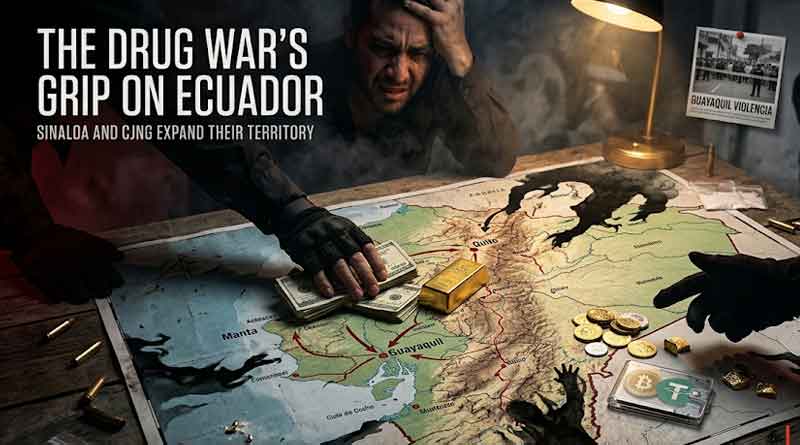

The Sinaloa Cartel and CJNG are devouring Ecuador, transforming a once-peaceful nation into a battleground for transnational organized crime, corrupting its institutions, and exploiting its natural resources and financial systems. This alarming transformation, spanning over two and a half decades, sees Mexico’s most powerful criminal organizations extend their brutal rivalry and illicit operations far beyond their traditional borders, effectively turning Ecuador into a crucial operational hub and a new “colony” for their vast criminal empires.
For years, Ecuador was primarily viewed as a transit country for cocaine flowing from Colombia and Peru to markets in North America and Europe. However, the dynamics have shifted dramatically. The source text reveals a nation grappling with an unprecedented surge in violence, economic distortion, and profound institutional fragility, all orchestrated by the insidious reach of these Mexican cartels. Their influence now permeates every layer of Ecuadorian society, from its political offices and judicial system to its remote mining regions and burgeoning digital economy.
The scale of this crisis is staggering. The year 2025 alone witnessed a harrowing 10,630 homicides linked to organized crime, marking it as the most violent year in Ecuador’s history, with an average of 850 deaths per month. This isn’t just about drug trafficking; it’s about a sophisticated, diversified criminal enterprise that has found fertile ground in Ecuador’s vulnerabilities, expanding its portfolio to include everything from illegal mining and cryptocurrency investments to human trafficking and the exploitation of Amazonian species, all facilitated by a web of corruption that cripples the state’s ability to respond.
How Mexican cartels established a foothold in Ecuador
Mexican cartels established a significant foothold in Ecuador through a combination of strategic alliances with local gangs, the corruption of high-ranking officials, and the exploitation of the country’s geographic location as a key transit point for illicit goods. Their initial entry was subtle, building relationships and infrastructure necessary for drug transshipment, but over time, these roots deepened, allowing them to exert immense influence.
Ecuador’s strategic position, nestled between major cocaine-producing nations like Colombia and Peru and offering direct Pacific access, made it an irresistible logistical hub for cartels. What began as a facilitative role for local criminal groups quickly morphed into a direct and commanding presence by Mexican organizations. They didn’t just pass through; they invested in local networks, bribed officials, and leveraged their vast resources to embed themselves within the country’s fabric. This allowed them to control entire supply chains, from procurement in source countries to distribution channels that reach global markets, solidifying their power and ensuring their operations ran with minimal state interference.
The cartels’ strategy was multifaceted: they identified weak points in governance, exploited socio-economic disparities, and systematically corrupted individuals in positions of power. This wasn’t merely about paying off a few low-level officials; it involved infiltrating the highest echelons of political and military structures, turning key figures into their operatives. This deep penetration allowed them to operate with near impunity, transforming Ecuador from a mere stopover into a critical operational base where their illicit activities could thrive and expand, unhindered by effective law enforcement.
The evolution of criminal influence: From drug routes to economic colonization
The evolution of criminal influence in Ecuador has transformed the nation from a mere drug transit route into an economically colonized territory where cartels diversify their illicit earnings into legitimate-appearing sectors like Bitcoin and gold mining. This strategic shift allows them to launder vast sums of money, making their illegal gains appear legitimate and further entrenching their power within the national economy.
The cartels’ initial focus was on securing drug routes, leveraging Ecuador’s Pacific coastline and porous borders. However, as their profits swelled and law enforcement efforts, however sporadic, became more sophisticated, these organizations realized the necessity of diversifying their portfolios. They began to invest heavily in sectors that offered both high returns and opportunities for large-scale money laundering. **Bitcoin and other cryptocurrencies** became attractive due to their decentralized nature and the relative anonymity they offered, making it difficult for authorities to trace transactions. This digital frontier provided a new, less detectable avenue to move and clean their money, bypassing traditional banking systems that had some level of oversight.
Simultaneously, the cartels aggressively moved into the **mining sector, particularly gold**. Ecuador is rich in “rare metals,” with 20 of its 24 provinces boasting significant reserves. Gold, unlike digital assets, offers a tangible asset that can be easily converted, transported, and integrated into global markets. The source text highlights how gold is used to “resguardar su dinero” (safeguard their money) and sent to the Middle East. This involves establishing phantom companies, often shell corporations with no real assets or operations, to facilitate the illegal extraction and export of gold. Once the gold is purchased, refined into ingots, and ostensibly exported through these front companies, it enters the legitimate global market, effectively “cleaned” of its illicit origins. This process not only provides a powerful mechanism for money laundering but also allows cartels to exert control over lucrative natural resources, often at the expense of local communities and the environment, further solidifying their economic colonization.
A history of corruption: Key figures and cartel infiltration
A history of corruption underscores the profound cartel infiltration in Ecuador, exemplified by high-profile figures like César Fernández and Telmo Castro, whose cases exposed the deep penetration of organized crime into the country’s political and military structures. These instances reveal a systematic effort by cartels to subvert state authority from within, paving the way for their expansive operations.
The relationship between Mexican cartels and Ecuadorian power structures first came to public light in a dramatic fashion in 2003. **César Fernández, then the governor of Manabí province**, was apprehended red-handed, caught loading cocaine onto a plane owned by none other than Joaquín “El Chapo” Guzmán, the infamous leader of the Sinaloa Cartel. This incident wasn’t an isolated act of petty corruption; it was a stark revelation of how high the cartels’ influence reached, demonstrating their ability to enlist senior government officials to facilitate their drug trafficking operations. Fernández’s involvement indicated a sophisticated network of complicity, where political power was directly leveraged to serve criminal ends, providing protection and logistical support for illicit shipments.
Another critical figure in this web of corruption was **Captain Telmo Castro, an officer in the Ecuadorian Army**. Castro became “El Chapo’s right-hand man,” instrumental in constructing and managing the crucial drug routes from Colombia through Ecuador to Mexico. His military background provided invaluable expertise in logistics, security, and evasion tactics, allowing the Sinaloa Cartel to establish highly efficient and secure corridors for cocaine transshipment. Castro’s influence within the military meant that these operations could proceed with minimal interception, as he could manipulate checkpoints, intelligence, and personnel to ensure the safe passage of drugs. Tragically, Castro’s story ended violently; in 2019, he was found dead in a Guayaquil prison, stabbed 15 times, while serving a 13-year sentence for drug trafficking. His death, likely an execution to silence him or send a message, underscores the brutal consequences of entanglement with these cartels. His legacy, however, lives on in a *corrido* (a Mexican ballad) dedicated to him by the group Edición Especial, which chillingly narrates how “with government trucks, that’s what we work with… the uniform well-worn so checkpoints give us passage, and don’t check bags that come full of white powder.” This cultural artifact not only immortalizes his role but also highlights the brazenness with which cartels exploited state resources and personnel.
The bloody vacuum: How El Chapo’s capture fueled Ecuador’s cartel war
El Chapo’s capture in 2014 and again in 2016 created a bloody power vacuum within the Sinaloa Cartel’s operations, which the rival Jalisco New Generation Cartel (CJNG) swiftly exploited, directly fueling an unprecedented cartel war in Ecuador. This disruption of the established criminal order unleashed a torrent of violence as both Mexican cartels vied for control over lucrative drug routes and territories.
For years, the Sinaloa Cartel, under El Chapo’s leadership, had largely dominated the drug trade through Ecuador, maintaining a relatively stable, albeit brutal, criminal ecosystem. However, his successive arrests destabilized this dominance, creating an opportunity for the ambitious and notoriously violent CJNG, led by Nemesio Oseguera Cervantes, “El Mencho.” The CJNG saw this as a strategic moment to expand its empire, sending emissaries to Ecuador to forge new alliances with local criminal organizations. This move was not just about seizing a piece of the pie; it was about asserting supremacy and challenging the Sinaloa Cartel’s long-standing influence.
The CJNG strategically partnered with powerful Ecuadorian gangs such as **Los Lobos, Los Tiguerones, and Los Lagartos**. These local groups, eager for more power and resources, quickly became the boots on the ground for El Mencho’s cartel, executing its directives and expanding its reach. In response, the Sinaloa Cartel, despite its leader’s absence, solidified its existing ties with its primary local ally, **Los Choneros**. This clash of alliances ignited a ferocious conflict, transforming Ecuador into an extension of the cartel wars typically seen in Mexico. The result was a devastating wave of violence that engulfed both the streets and, most horrifically, the penitentiary system, as rival gangs, now proxies for Mexican cartels, battled for control over drug routes, extortion rackets, and internal prison territories. The vacuum created by El Chapo’s fall thus became a catalyst for Ecuador’s descent into an internecine criminal conflict, with ordinary citizens bearing the brunt of the escalating brutality.
Ecuador’s descent into chaos: Prison massacres and street terror
Ecuador’s descent into chaos is vividly illustrated by a horrifying surge in prison massacres and widespread street terror, directly resulting from the escalating proxy war between Mexican cartels and their local allies. These events have left hundreds dead and shattered the public’s sense of security, revealing the profound breakdown of state control.
Alexander Levoyer, the former director of Joint Operations for the Armed Forces, recounted the horrific period between 2021 and 2023, during which **11 major massacres occurred in various prisons across the country, claiming over 400 lives**. These weren’t isolated incidents but coordinated assaults, often involving rival gangs (proxies for the Mexican cartels) battling for control within the penitentiary system. The brutality was extreme, with inmates often decapitated, dismembered, or burned alive. President Daniel Noboa’s administration responded with states of exception, deploying military forces to regain control of the prisons. However, these efforts proved immensely challenging, as the cartels’ influence inside the prisons was deeply entrenched, often involving corrupt guards and sophisticated communication networks that allowed them to coordinate attacks and receive weapons.
The violence was not confined to prison walls; it spilled out onto the streets, terrorizing the civilian population. Levoyer detailed a surge in **kidnappings, robberies, and extortion**, which became daily occurrences. Criminal groups grew bolder, launching attacks on police units and even attempting to infiltrate military installations, leading to numerous deaths and injuries among security forces and civilians alike. The level of sophistication and brutality of these criminal acts shocked the nation. Levoyer noted that tactics previously “only seen in Colombia and Mexico” began to appear in Ecuador, such as **decapitations and bodies hung from bridges**. These gruesome displays were direct influences from Mexican and Colombian cartels, designed to instill fear and assert dominance. He chillingly revealed that some of these criminals were “trained by Al Qaeda, Mexico, and Colombia,” indicating a level of tactical expertise and ruthlessness that Ecuador’s military was unprepared to combat. The ultimate symbol of this brazenness was when “these criminal groups entered or broke into a television channel,” taking journalists hostage during a live broadcast, a chilling act of terrorism broadcast globally and demonstrating the cartels’ audacious challenge to state authority and public order.
When justice falters: Judicial corruption and impunity’s reign
When justice falters in Ecuador, it directly enables the reign of impunity for cartels, largely due to widespread judicial corruption and an overwhelmed legal system incapable of processing the sheer volume of cartel-related crimes. This systemic breakdown allows criminals to evade accountability, further emboldening their operations.
Patricio Carrillo, Ecuador’s former Minister of the Interior, highlighted the critical role of a compromised judicial system in perpetuating the crisis. He explained that **”the procedural system could not cope; the judicial system was designed with few experts, prosecutors, and judges, who had to handle one thousand, one thousand five hundred deaths throughout the country.”** This severe under-resourcing meant that the vast majority of cases, particularly those involving complex organized crime, were either poorly investigated, delayed indefinitely, or simply “archived and in impunity.” The system was not merely overwhelmed; it was actively undermined by corruption. **Many judges, prosecutors, and even defense attorneys were “bought by organized crime,”** leading to the liberation of dangerous criminals who had been painstakingly apprehended by the police and military. This cycle of arrest and release created a profound sense of disillusionment among law enforcement and the public, signaling that justice was for sale and that the cartels operated above the law. The lack of accountability not only allowed cartel members to continue their illicit activities but also fostered a climate of fear, where witnesses and honest officials were reluctant to cooperate, knowing that their efforts might be futile or even put their lives at risk. The result is a society where the rule of law is severely eroded, and the cartels effectively dictate the terms of justice.
The assassination that shook a nation: Villavicencio’s tragic end
The assassination of presidential candidate Fernando Villavicencio in August 2023 profoundly shook Ecuador, serving as a stark and tragic testament to the cartels’ audacious reach and their willingness to silence any perceived threat to their power. This act of political violence underscored the extreme vulnerability of the democratic process in the face of entrenched organized crime.
On August 9, 2023, **Fernando Villavicencio was brutally gunned down in Quito following a campaign event**, just days before the presidential election. A former journalist and outspoken critic of corruption and organized crime, Villavicencio had made the fight against cartels a central pillar of his campaign. His fearless stance, however, came at an ultimate price. According to Ecuadorian intelligence reports and his own advisor, Patricio Zuquilanda, Villavicencio had received numerous death threats during his campaign, with one particularly prominent threat attributed directly to the **Sinaloa Cartel**. This direct targeting of a presidential candidate by a major transnational criminal organization sent shockwaves across Ecuador and the international community, highlighting the existential threat posed by these groups to the country’s democratic institutions.
Further investigations into the assassination also pointed to the involvement of **Los Lobos, a powerful local gang allied with the CJNG, and its leader, Juan Carlos Montero Mestre**, as potentially being behind the intellectual authorship of the murder. This dual attribution of threats and responsibility underscores the complex and interconnected web of cartel operations in Ecuador, where Mexican cartels leverage local proxies to execute their most brazen acts. The assassination of Villavicencio was not just an attack on a political figure; it was an attack on the very foundations of Ecuadorian democracy, a clear message from the cartels that they would tolerate no opposition to their burgeoning power. It marked a terrifying escalation in the conflict, demonstrating that no one, not even a presidential candidate, was immune to their reach, and that the cartels were willing to use extreme violence to maintain their grip on the nation.
The new frontier of illicit finance: Bitcoin, gold, and money laundering
The new frontier of illicit finance for cartels in Ecuador involves sophisticated money laundering schemes utilizing Bitcoin, gold, and a network of phantom companies, allowing them to clean billions of dollars from their criminal enterprises. This evolution showcases their adaptability and their exploitation of modern financial systems and natural resources.
Following the intense violence and the government’s declaration of cartels as “terrorist organizations” under President Noboa, a tense calm, dubbed “Pax Narcoecuatoriana,” emerged. This period prompted cartels to innovate, devising new methods for illicit income generation and money laundering that could evade heightened scrutiny. In 2025, the UN Office for the Andean Region and the Southern Cone issued a stark warning: Ecuador faced a growing threat from **asset laundering linked to drug trafficking, corruption, tax evasion, environmental crimes, and human trafficking**. These activities, the report detailed, “generate billions of dollars that are reintegrated into the financial system, perpetuating violence, insecurity, and institutional instability, in addition to distorting markets and impeding sustainable development.”
Arturo Torres, an Ecuadorian security specialist, corroborated these findings, specifically pointing to the surge in **cryptocurrency investments, especially Bitcoin**, as a primary method for cartels to launder their money. “The main crimes that have grown are financial crimes, such as cryptocurrencies in the financial system. That’s where drug traffickers are using their money, that’s where they are investing,” Torres explained. He critically noted that “banks and the financial system do not have sufficient controls to face this phenomenon,” highlighting a significant vulnerability that cartels are expertly exploiting. The decentralized and often anonymous nature of cryptocurrencies makes them ideal for moving large sums of illicit cash across borders without triggering the red flags associated with traditional banking transactions. This allows cartels to quickly convert dirty money into digital assets, transfer them globally, and then convert them back into fiat currency, effectively sanitizing their illegal gains.
Beyond digital assets, the cartels are also heavily invested in **illegal gold mining and its subsequent export**. Ecuador’s rich mineral deposits, particularly gold in 20 of its 24 provinces, offer a tangible and highly valuable asset for money laundering. The source text describes how women frequently travel on 36-hour flights from Quito to Dubai, laden with dozens of gold articles, to smuggle and launder money in the United Arab Emirates. More systematically, cartels use gold to form ingots, which are easier to transport and face fewer restrictions than other illicit goods. This process is facilitated by **”phantom companies” or shell corporations**, created solely on paper to legitimize the gold’s origin and facilitate its export. “Once you buy the gold and it becomes an ingot, it enters the market clean,” Torres elaborated. “It no longer carries the burden of being cocaine.” Since 2020, cartels have significantly ramped up their involvement in illegal mining and gold exports, creating fictitious companies to send gold to countries like Qatar, India, and Switzerland. This strategy is particularly attractive because “gold becomes much more valued than cocaine itself because it costs four times more, you earn much more, the risk is much lower.” This diversification into hard assets and digital currencies demonstrates the cartels’ sophisticated adaptation to law enforcement pressures, finding new and less risky ways to grow and legitimize their colossal profits, further solidifying their economic grip on Ecuador.
Ecuador: From transit point to criminal investment hub
Ecuador has tragically transformed from a mere drug transit point into a sophisticated criminal investment hub, where Mexican cartels diversify their illicit activities beyond narcotics to include illegal mining, extortion, human trafficking, and species trafficking. This evolution underscores their adaptability and the comprehensive nature of their criminal enterprises.
The cartels’ strategic pivot from primarily using Ecuador as a logistical corridor for drug shipments to establishing it as a multifaceted investment and operational base marks a critical turning point. This shift is not just about expanding their illicit portfolio; it’s about optimizing their profits and reducing risks. As security specialist Arturo Torres explains, **”Now we talk about transnational holdings dedicated to different crimes: at one moment they can use drug trafficking, and if there is a lot of control, they go to illegal mining, to extortion, to human trafficking, or to the trafficking of Amazonian species, because they use the same routes, the same logistics, the same corrupt operators within the State.”** This statement perfectly encapsulates the cartels’ dynamic and opportunistic approach. When one avenue becomes too risky or heavily policed, they seamlessly transition to another, leveraging the same established networks, corrupt officials, and logistical infrastructure they’ve already built.
This diversification means that the impact on Ecuador is far more pervasive than just drug-related violence. Illegal mining, for instance, devastates the environment, pollutes rivers with mercury, and often displaces indigenous communities. Extortion rackets cripple legitimate businesses and instill widespread fear. Human trafficking exploits vulnerable populations, while the trafficking of Amazonian species contributes to ecological destruction and threatens biodiversity. Each of these activities generates immense profits, which are then laundered through the sophisticated financial mechanisms discussed previously, further intertwining criminal money with the legitimate economy. Ecuador’s appeal as a criminal investment hub lies in its combination of rich natural resources, strategic geographic location, and, critically, its weakened state institutions and pervasive corruption. This environment allows cartels to operate with a degree of freedom and impunity that would be impossible in more robustly governed nations, making Ecuador a prime location for them to consolidate their power, expand their wealth, and solidify their status as transnational criminal empires.
The perilous path forward: Confronting a transnational criminal empire
The perilous path forward for Ecuador involves confronting a deeply entrenched transnational criminal empire that has infiltrated every aspect of its society, requiring not just law enforcement action but comprehensive institutional reform, international cooperation, and a unified national strategy. Without such a multi-pronged approach, the nation risks permanent subjugation to cartel rule.
President Daniel Noboa’s declaration of an “internal armed conflict” against these “terrorist organizations” and his commitment to a “mano firme” (firm hand) approach represent a critical step. However, the scale of the challenge is immense. Confronting entities that operate as sophisticated transnational holdings, diversifying across multiple illicit sectors and possessing immense financial and military power, demands more than just military might. It requires a fundamental rebuilding of the state’s capacity to govern, to enforce laws, and to provide justice.
Key areas for action include:
- Strengthening the judicial system: Eradicating corruption within the courts, increasing the number of judges and prosecutors, and providing them with adequate resources and protection are paramount. Without a functional justice system, arrests mean little, and impunity will continue to reign.
- Enhancing financial controls: Implementing robust anti-money laundering regulations, particularly for cryptocurrencies and the mining sector, is crucial. International cooperation is vital to track and seize illicit assets moved through global financial networks.
- International cooperation: Ecuador cannot face this threat alone. Collaboration with countries like the United States, Colombia, and Mexico, as well as international bodies like the UN, is essential for intelligence sharing, capacity building, and coordinated operations against transnational criminal networks.
- Addressing root causes: While security is immediate, long-term solutions must address socio-economic disparities, lack of opportunities, and weak governance that make communities vulnerable to cartel recruitment and exploitation.
- Protecting democratic institutions: Safeguarding elections, political candidates, and the media from cartel intimidation and infiltration is fundamental to preserving the country’s democratic fabric.
Ecuador stands at a crossroads. The choice is between continuing to be devoured by these criminal enterprises or embarking on a long, arduous, but necessary journey to reclaim its sovereignty, strengthen its institutions, and secure a future free from the shadow of transnational organized crime. The global community has a vested interest in supporting Ecuador, as the unchecked expansion of these cartels poses a threat not just to one nation, but to regional stability and international security.