
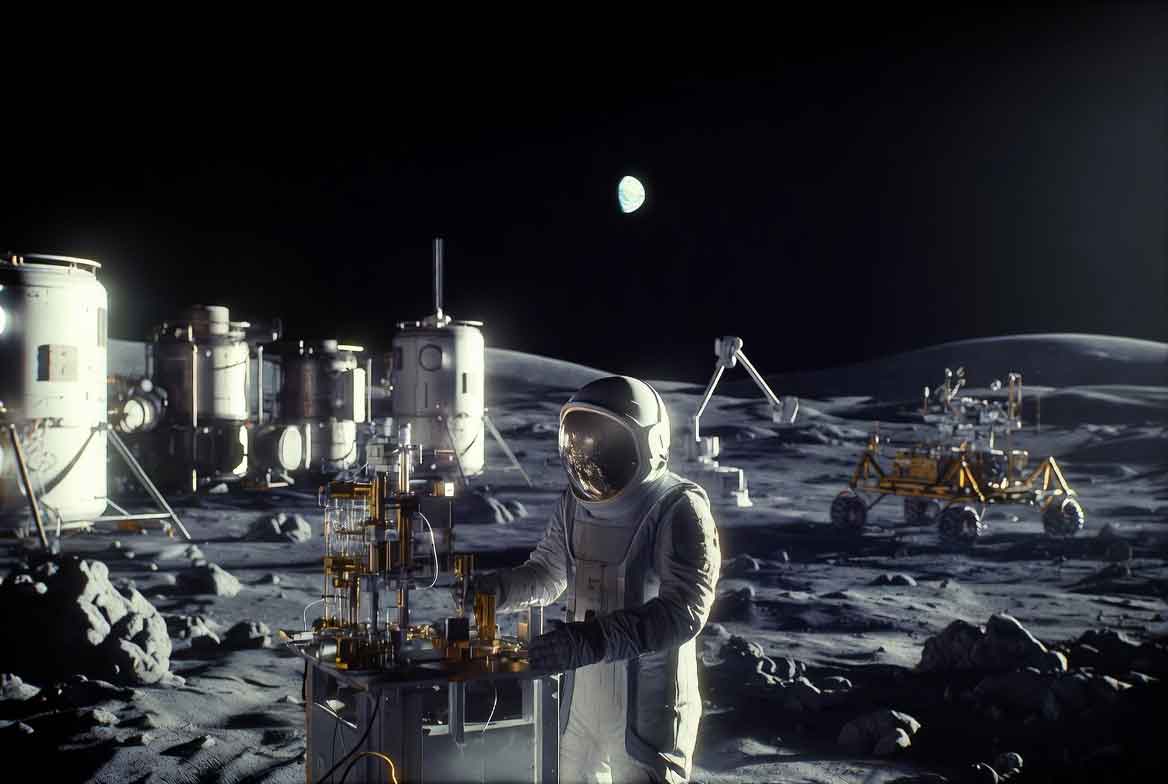

The dream of having a permanent human base on the Moon is becoming increasingly tangible. During an event held at NASA’s headquarters in Washington, the US space agency announced new contracts for crewed lunar vehicles and uncrewed cargo modules destined for the Moon. The agency’s leaders also shared the expected launch timelines and upcoming milestones for the first infrastructure and exploration missions of the Future Lunar Base in the South Pole region, prior to the Artemis program’s lunar landings.
The future lunar base will be the first advanced outpost of the United States and humanity on another celestial body, according to NASA Administrator Jared Isaacman. “Each mission, crewed or uncrewed, will be a learning opportunity as we return to the lunar surface, build the necessary infrastructure to stay there, and master the skills required to live and operate in one of the most demanding and hazardous environments imaginable.” The agency’s goals for the future lunar base include advancing science, driving economic and technological gains, and improving life on Earth, while also preparing for the next destination.
The Roadmap to the Future Lunar Base
There is already a defined calendar for the future lunar base. Three missions, dubbed “Lunar Base,” are planned, which will involve a series of robotic operations designed to prepare for sustained human presence on the Moon in the coming years. These missions aim to test technologies, transport scientific equipment, and develop the necessary infrastructure for future crewed expeditions under the Artemis program. The first mission, Lunar Base I, is scheduled for no earlier than autumn 2026 and will utilize the Blue Moon Mark 1 Endurance lander, developed by Blue Origin, to carry NASA scientific instruments to the lunar surface.
The landing will occur at the Shackleton Connecting Ridge, a strategic area near the lunar south pole, due to its lighting conditions and potential access to water ice. Among the instruments on this mission will be the Lunar Surface Stereo Camera System (LSS), which will analyze how landing engines interact with lunar dust and soil, and the Laser Retroreflector Array (LRA), a device that reflects laser beams sent from spacecraft in orbit or from Earth to determine positions with high precision. The overall goal of Lunar Base I is to reduce risks and validate capabilities before the future crewed Artemis missions planned for 2028.
Upcoming Missions and International Collaboration
The second mission, Lunar Base II, could launch as early as the end of this year, with the Griffin lander, developed by Astrobotic, carrying over 500 kilograms of payload, including the FLIP rover, developed by Astrolab. This mission aims to test advanced mobility systems on the Moon, which could enable future lunar vehicles to transport astronauts, instruments, and supplies on prolonged missions. The third mission, Lunar Base III, is also scheduled for this year and will have a scientific and international focus, with the Nova-C Trinity lander, developed by Intuitive Machines, carrying the Lunar Vertex experiment to study “lunar swirls,” mysterious bright regions on the Moon’s surface.
These missions mark the beginning of a new era in lunar exploration, with the future lunar base at the forefront. The NASA plans to announce over a dozen more missions this year, all aimed at gathering operational data, testing technologies, and reducing risks before the crewed Artemis missions. The agency’s emphasis on international collaboration and commercial partnerships underscores the significance of the future lunar base as a stepping stone for further human exploration and development of the Moon.
FAQs
1. What is the primary goal of the Lunar Base missions?
The primary goal of the Lunar Base missions is to prepare for sustained human presence on the Moon by testing technologies, transporting scientific equipment, and developing the necessary infrastructure for future crewed expeditions.
2. When is the first Lunar Base mission scheduled to launch?
The first Lunar Base mission, Lunar Base I, is scheduled to launch no earlier than autumn 2026.
3. What is the significance of the Shackleton Connecting Ridge landing site?
The Shackleton Connecting Ridge is a strategic area near the lunar south pole, due to its lighting conditions and potential access to water ice, making it an ideal location for future human missions.